Here's the uncomfortable truth most players discover eventually: the hours you spend at the piano matter far less than what you do with them. Two people can practice the same amount and end up years apart in skill. The difference is method. Below are seven practice techniques that consistently produce fast, durable improvement, the same ones serious musicians and teachers rely on. Master these and you'll get more from twenty focused minutes than you used to get from an aimless hour.
Metronome
Practise in time with a steady, accurate click.
Why "playing through" a piece isn't practice
Most people sit down, open their music, and play the whole thing start to finish. It feels productive, it's enjoyable, and it barely helps. When you play through a piece, you spend most of your time rehearsing the parts you can already play, and you rush past the handful of bars that actually need work, usually stumbling in the same spots every single time. You're not fixing the problem; you're rehearsing the mistake until it's permanent.
Playing is performing. Practice is problem-solving. If a session feels effortless and sounds good the whole way through, you're probably not practicing; you're just enjoying what you already know.
Real practice is deliberate practice: working at the edge of your ability, on the specific things you can't yet do, with full attention and immediate correction. It's less comfortable than playing through, and that discomfort is the whole point.
The 7 methods that actually work
- Warm up and set one clear goal. Spend a few minutes loosening your hands with scales or a simple exercise, then decide the single thing this session is for: "smooth out bars 12–16," "play the left hand from memory," "hold a steady tempo through the chorus." One session, one target. Vague intentions produce vague results.
- Break the piece into small sections. Don't practice a song; practice a phrase, sometimes just two bars. Small chunks fit in your working memory, so you can actually notice and fix what's going wrong. Master a section, then link it to the next. This is how big pieces get learned: one solvable piece at a time.
- Practice slowly and accurately. Speed is a by-product of accuracy, never a substitute for it. Play a passage slowly enough that you make zero mistakes, because your fingers memorize whatever you feed them, including errors. Slow, clean repetitions build a reliable foundation; fast, sloppy ones build a habit you'll spend weeks unlearning.
- Isolate the hardest passages. Find the two or three spots that trip you up and give them the majority of your time. It's counterintuitive (we love replaying the easy, satisfying parts) but your progress lives entirely in the hard bars. Attack them directly and the whole piece rises with them.
- Hands separately, then together. When a passage fights back, split it. Play the left hand alone until it's automatic, then the right, then combine them slowly. Each hand has its own job, and asking your brain to coordinate two unlearned parts at once is why so many pieces feel impossible. Separate, master, reunite.
- Use a metronome and raise the tempo gradually. Set it to a speed where the passage is clean, play it correctly several times, then nudge the tempo up a few beats and repeat. This "ratchet" approach builds speed you can trust. A metronome also exposes the timing flaws you can't hear on your own: the rushing, the dragging, the uneven rhythms.
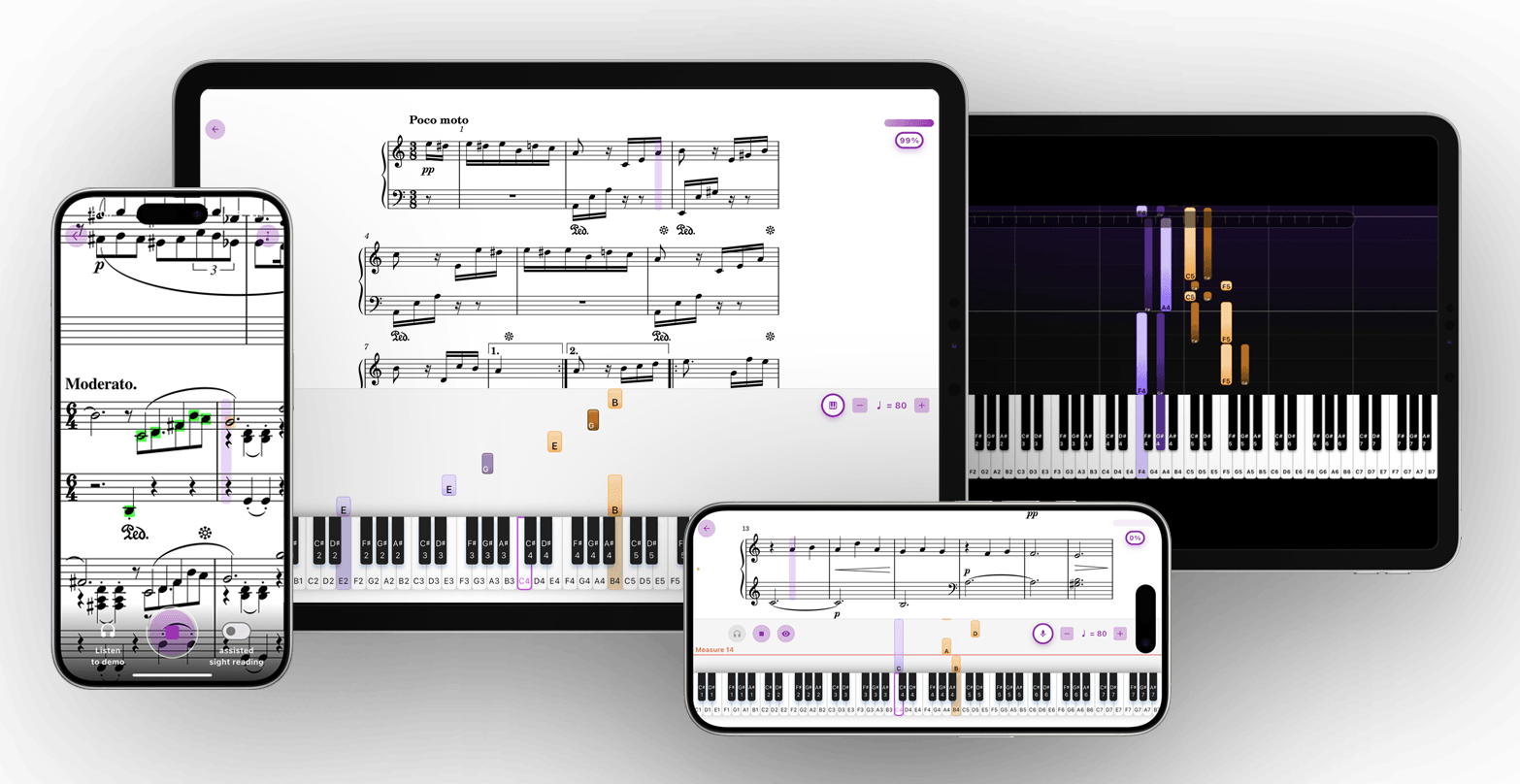
- Get feedback on your playing. You can't fix what you can't hear, and every player has blind spots: a rushed run, an uneven left hand, a chord that's slightly off. A teacher is the classic solution. When one isn't in the room, tools like Harmono's Audition mode listen to your real acoustic or digital piano and give masterclass-style feedback on your timing and accuracy, so you catch mistakes before they harden into habits. Objective feedback is the single biggest accelerator in this list.
Make it stick: spacing, consistency, and repetition
How you space your practice matters as much as what you do in it. Your brain consolidates motor skills between sessions, during rest and sleep, which is why four focused 20-minute sessions across a week beat one exhausting two-hour cram. This is spaced repetition at work, and it's why consistency quietly outperforms intensity. A little every day compounds; a lot once a week evaporates.
Returning to a tricky passage tomorrow, then again in a few days, forces your brain to rebuild the memory each time, and each rebuild makes it stronger and more permanent than any single marathon session ever could. If you're curious how this compounds over months, our guide on how long it takes to learn piano lays out realistic timelines, and adult learners will find a schedule-friendly approach in how to learn piano as an adult.
Track your progress
Progress at the piano is slow enough to feel invisible day to day, which is why so many people quit right before it clicks. Keep a simple log: which piece, which bars, what tempo, what you fixed. A quick note like "Prelude, bars 9–16, 72 bpm clean" turns a foggy sense of "am I even improving?" into visible evidence that you are.
| Instead of... | Try... | Why it works |
|---|---|---|
| "I'll practice the song" | "I'll fix bars 12–16" | A specific target you can actually finish |
| Playing fast to sound good | Playing slow to play clean | Accuracy first; speed follows automatically |
| Replaying the easy parts | Drilling the hard bars | Progress lives where the difficulty is |
| One long weekly session | Short daily sessions | Skills consolidate between practices |
Avoiding burnout
Deliberate practice is demanding, and staying in problem-solving mode indefinitely is a fast route to frustration. Protect your motivation:
- End on a win. Finish each session by playing something you love and can already play well. You'll leave the bench happy and want to come back.
- Keep sessions short and focused. Twenty attentive minutes beat an hour of drifting. Stop before you're mentally fried, not after.
- Balance work and joy. Not every session needs to be pure drilling. Mix in songs you're playing purely for fun to keep the whole thing sustainable.
- Choose music you actually want to play. Motivation is the real limiting factor. Learning to turn a song you love into a tutorial makes practice something you look forward to.
The bottom line
Effective practice isn't about grinding for hours. It's about attention, accuracy, and honest feedback aimed at the exact things you can't yet do. Warm up with a goal, break the music down, play slow and clean, isolate the hard parts, split your hands, ratchet up tempo with a metronome, and check your work against real feedback. Do that consistently, track it, and protect your motivation, and you'll improve faster than you thought possible, with less time at the bench, not more.