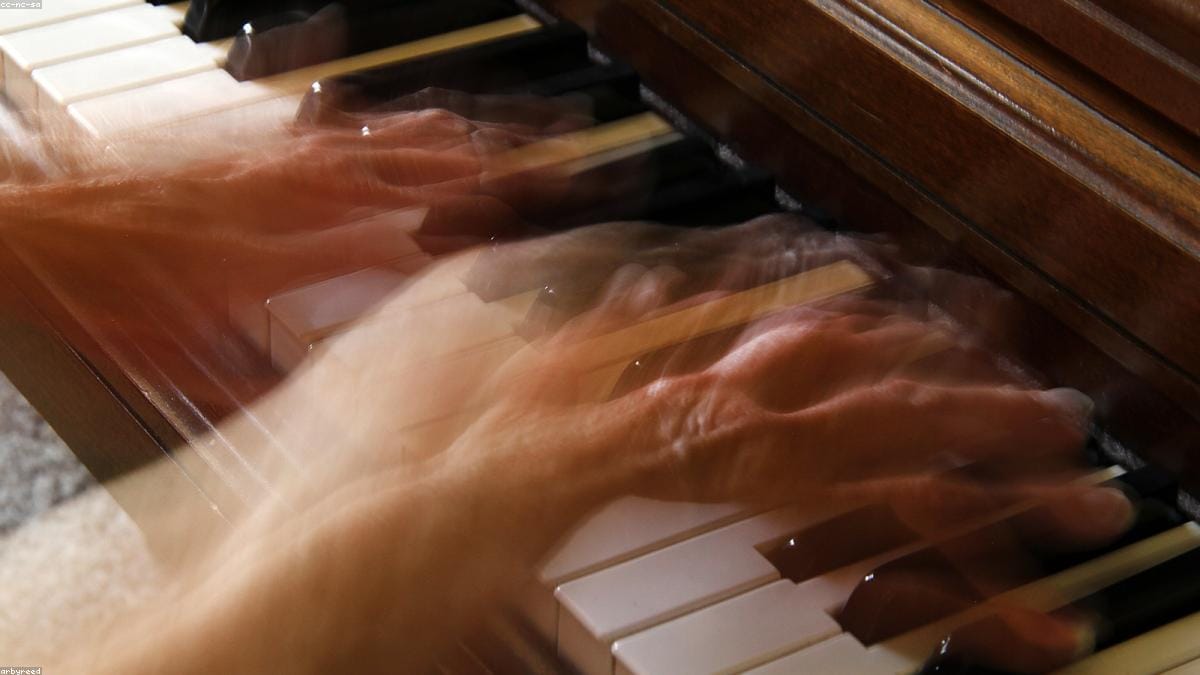
There's a special kind of motivation that comes from playing a song people actually recognize. Scales and exercises have their place, but nothing keeps you coming back to the piano like the moment a real tune emerges from under your hands. The good news: plenty of easy piano songs for beginners sound genuinely great, not like practice drills. Below are well-loved pieces you can start today, what makes each one approachable, and a simple method for learning any song you want, even the one stuck in your head right now.
What makes a song beginner-friendly
Before the list, it helps to know why some songs are so much easier to learn than others. When you can spot these traits yourself, you can pick your own beginner songs with confidence instead of guessing. The friendliest first pieces usually share three qualities:
- A simple, stepwise melody. Notes that move mostly to their neighbors, rather than leaping all over the keyboard, are far kinder to new fingers.
- Few hand movements. If your hand can stay in one position for most of the song, you spend your attention on rhythm and sound instead of hunting for keys.
- Repetition. Repeated phrases and a small set of chords mean that once you learn a little, you already know a lot of the song.
Notice that "easy" has nothing to do with how impressive the song sounds. Many of the most satisfying beginner pieces are built on just a handful of repeating chords, which is exactly why they feel good to play so soon.
Easy piano songs that sound great
Here's a starter set of well-known pieces, ordered roughly from simplest to slightly more involved. These aren't a strict difficulty ranking, everyone's hands and background differ, but they're a reliable path from your very first notes toward songs friends will recognize.
| Song | Why it's easy | Skills it builds |
|---|---|---|
| "Hot Cross Buns" | Just three notes, one hand, tons of repetition | Finger independence, steady rhythm |
| "Ode to Joy" (Beethoven) | Stepwise melody that stays in one hand position | Reading by step, smooth phrasing |
| "Happy Birthday" | Everyone knows the tune, so your ear guides you | Playing by ear, dotted rhythms |
| "Heart and Soul" | A short repeating chord pattern in the left hand | Hands together, chord accompaniment |
| "Für Elise" (opening) | The famous first phrase is small and repetitive | Alternating fingers, light touch |
| Four-chord pop songs (e.g. "Let It Be") | The same four chords loop through the whole song | Chord shapes, playing and singing |
| "Clocks" (Coldplay) | A simple repeating broken-chord pattern | Arpeggios, keeping a groove |
| "Married Life" (from Up) | Gentle, repetitive left-hand waltz pattern | Expression, coordinating both hands |
A quick honest note: how hard a piece feels depends a lot on the arrangement. "Für Elise" has a simple opening and a much trickier middle; "Clocks" can be played as a beginner loop or a fuller version. Start with the simplest arrangement you can find, and grow into the harder parts later.
How to actually learn a song (without frustration)
The single biggest mistake beginners make is trying to play a whole song, both hands, at full speed, from the start. That's the fast track to feeling stuck. Instead, break the work into small, winnable pieces:
- Chop it into sections. Learn four to eight bars at a time. A song is far less intimidating as five little chunks than as one long page.
- Hands separately first. Get the right hand comfortable, then the left, before you ask them to cooperate. Each hand learns its job without competing for your attention.
- Slow, then smooth, then up to speed. Play slowly enough to hit every note correctly. Speed is a side effect of accuracy, not something you force.
- Join the hands on the small section. Only combine hands once each is solid on its own, and only on that short chunk.
- Stitch the sections together. Link chunk one to chunk two, then add the next, until the whole song flows.
This is the same approach that works for advanced pieces too, just on a larger scale. If you want to go deeper, our guide on how to practice piano effectively covers exactly how to spend your minutes so they count, and reading sheet music for beginners helps you decode a new score faster.
Play a song at a tempo where you can't make a mistake, then let the tempo rise on its own. Your hands remember what they do correctly, not what they do quickly.
The chords behind hundreds of songs
Here's a secret that makes the beginner songbook feel enormous: a huge share of popular music runs on the same few chords. Learn a handful of common shapes and you can accompany yourself through countless tunes, swapping the melody on top. If you've ever heard that "four chords play every pop song," that's only a slight exaggeration.
Spend a little time with a chart of common chords and you'll start recognizing the same patterns everywhere. From there, learning a new song often means learning just its melody and which chords repeat, rather than every single note.
How to learn ANY song you want
The songs above are great starting points, but the real motivation is playing the specific song you love, the one that made you want to learn in the first place. That song might not have a beginner tutorial anywhere. So what do you do?
This is where modern tools change the game. With Harmono, you can turn any song's audio into a play-along piano tutorial: it listens to the recording, works out the notes and chords, and lays them out as falling notes you can follow at your own pace. Instead of waiting for someone else to teach your favorite song, you generate the lesson yourself. It's the closest thing to having every song in the world in beginner mode.
That said, being able to reach for a song by ear is a skill worth building alongside any tool. As you play more, you'll start hearing which notes and chords are coming next, and our guide on how to play piano by ear will speed that instinct along.
Your next step
Pick one song from the table above that you genuinely want to hear yourself play, ideally one you can already hum. Learn just its first section, hands separately, slowly, today. That small win is the whole game: it proves you can do this, and it makes the next section, and the next song, feel possible. Beginner songs aren't a consolation prize on the way to "real" music. Played well, they are real music, and they're waiting for you right now.